

Backtest to get funded

ForgeX is the first ever backtesting-only firm. We are the only backtesting software that pays for your next prop firm challenge. It is the only place where prop firm traders earn while they learn, so you can stop bleeding thousands on failed evals and start getting funded for it instead.

190M+tradeable candles 66tradeable instruments

Real bars with the spread that was actually quoted, checked before they are served.

From the guides

What the research says Why you sell winners and hold losers 10,000 accounts were examined. A position in profit was more than 50 percent more likely to be closed than one in loss, and it cost them 3.4 percent a year. What the research says What overconfidence costs a trader 35,000 households, split by expected confidence. The more confident group traded 45 percent more and gave up nearly a point more a year for it. What the research says What percentage of traders lose money Europe's regulator made brokers hand over their numbers. Between 74 and 89 percent of retail accounts lost money, and the average loss ran into thousands. What the research says Can you day trade for a living Two studies tracked hundreds of thousands of real day traders. 97 percent of those who kept at it lost money, and under 1 percent were reliably profitable. What the research says Does trading more often make you more money 66,465 households were tracked for six years. The ones who traded most earned 11.4 percent a year while the market returned 17.9 percent. Backtesting What backtesting is, and what it can and cannot tell you Backtesting means checking a trading idea against history before you risk money on it. Here is what it proves, what it does not, and where it misleads people. Backtesting How to backtest a trading strategy, step by step A plain walkthrough of manual backtesting. Write the rules down, pick the data, replay it bar by bar, record every trade, then read the result honestly. Backtesting How many trades do you need before a backtest means anything Ten trades settle nothing. Here is why small samples mislead, and how to tell a real result from a lucky one. Backtesting In sample and out of sample testing, explained simply Splitting the data is the cheapest way to catch a strategy that only works on the history it was built from. Here is the method and how to read the outcome. Backtesting Overfitting: how to tell a real edge from a curve fit Overfitting is what happens when you tune a strategy until it fits the past perfectly. Here is what causes it and how to catch it in a result before trusting it. Backtesting How far back should you backtest How much history a test needs depends on trade frequency and on which market conditions have to be covered. Here are the rough numbers and the reasoning. Backtesting Why your backtest beat your live results Almost everyone trades worse live than in testing. Here are the seven reasons why, and which of them you can actually fix. Risk and position sizing Position sizing, explained without the jargon How to work out how much to trade. The percent risk method, the maths behind it, and why sizing decides survival more than entries do. Risk and position sizing Risk of ruin, and the drawdown you should expect Even a winning strategy can lose everything at the wrong size. Here is what risk of ruin means, what drives it, and how to keep it near zero. Risk and position sizing Risk to reward and win rate: the trade off nobody explains A high win rate is not the goal. Here is how win rate and reward to risk fit together, and the break even table you can check your strategy against. Risk and position sizing What a normal losing streak looks like Long losing runs are a normal feature of a working strategy. Here is how long a run to expect at your win rate, and how to tell a normal one from a real problem. Prop firm challenges Why most people fail prop firm challenges It is rarely the profit target that stops people. Here are the real reasons challenges fail and what to do differently. Prop firm challenges Daily drawdown limits, and what trailing really means Static, trailing and end of day drawdown limits behave very differently. Here is how each one works with a worked example. Prop firm challenges Prop firm rules explained in plain words Profit targets, loss limits, minimum days, consistency rules and payout splits. What each rule means and which ones actually catch people out. What the research says Why you sell winners and hold losers 10,000 accounts were examined. A position in profit was more than 50 percent more likely to be closed than one in loss, and it cost them 3.4 percent a year. What the research says What overconfidence costs a trader 35,000 households, split by expected confidence. The more confident group traded 45 percent more and gave up nearly a point more a year for it. What the research says What percentage of traders lose money Europe's regulator made brokers hand over their numbers. Between 74 and 89 percent of retail accounts lost money, and the average loss ran into thousands. What the research says Can you day trade for a living Two studies tracked hundreds of thousands of real day traders. 97 percent of those who kept at it lost money, and under 1 percent were reliably profitable. What the research says Does trading more often make you more money 66,465 households were tracked for six years. The ones who traded most earned 11.4 percent a year while the market returned 17.9 percent. Backtesting What backtesting is, and what it can and cannot tell you Backtesting means checking a trading idea against history before you risk money on it. Here is what it proves, what it does not, and where it misleads people. Backtesting How to backtest a trading strategy, step by step A plain walkthrough of manual backtesting. Write the rules down, pick the data, replay it bar by bar, record every trade, then read the result honestly. Backtesting How many trades do you need before a backtest means anything Ten trades settle nothing. Here is why small samples mislead, and how to tell a real result from a lucky one. Backtesting In sample and out of sample testing, explained simply Splitting the data is the cheapest way to catch a strategy that only works on the history it was built from. Here is the method and how to read the outcome. Backtesting Overfitting: how to tell a real edge from a curve fit Overfitting is what happens when you tune a strategy until it fits the past perfectly. Here is what causes it and how to catch it in a result before trusting it. Backtesting How far back should you backtest How much history a test needs depends on trade frequency and on which market conditions have to be covered. Here are the rough numbers and the reasoning. Backtesting Why your backtest beat your live results Almost everyone trades worse live than in testing. Here are the seven reasons why, and which of them you can actually fix. Risk and position sizing Position sizing, explained without the jargon How to work out how much to trade. The percent risk method, the maths behind it, and why sizing decides survival more than entries do. Risk and position sizing Risk of ruin, and the drawdown you should expect Even a winning strategy can lose everything at the wrong size. Here is what risk of ruin means, what drives it, and how to keep it near zero. Risk and position sizing Risk to reward and win rate: the trade off nobody explains A high win rate is not the goal. Here is how win rate and reward to risk fit together, and the break even table you can check your strategy against. Risk and position sizing What a normal losing streak looks like Long losing runs are a normal feature of a working strategy. Here is how long a run to expect at your win rate, and how to tell a normal one from a real problem. Prop firm challenges Why most people fail prop firm challenges It is rarely the profit target that stops people. Here are the real reasons challenges fail and what to do differently. Prop firm challenges Daily drawdown limits, and what trailing really means Static, trailing and end of day drawdown limits behave very differently. Here is how each one works with a worked example. Prop firm challenges Prop firm rules explained in plain words Profit targets, loss limits, minimum days, consistency rules and payout splits. What each rule means and which ones actually catch people out.
New Funded Runs

Earn While You Learn

See more

Trader Journey →

Get paid for getting good at backtesting

A road that takes you from your first practice trade to a funded account, rewarding you at every milestone along the way. Wind any market back to a real day, prove your edge over real trades, climb a battle-pass style rewards road, and claim a free prop-firm evaluation or cash toward a payout.

See the Trader Journey

Every trade, written down without you typing

  • Backtesting journal Every trade you take in a replay session is recorded on its own, with the chart saved at entry and at exit.
  • Live journal Connect a broker account and your real trades land in the same place, in the same shape, next to the practice ones.
  • Book journal The whole record as a book that opens. Pick a cover, turn the pages, and read a month back the way a notebook reads.
Learn more about it

Prop firms →

Take the test before you pay for it

The same profit target and the same loss limits as the real thing, with no entry fee. Find out how a challenge goes before paying for one.

See prop firm practice
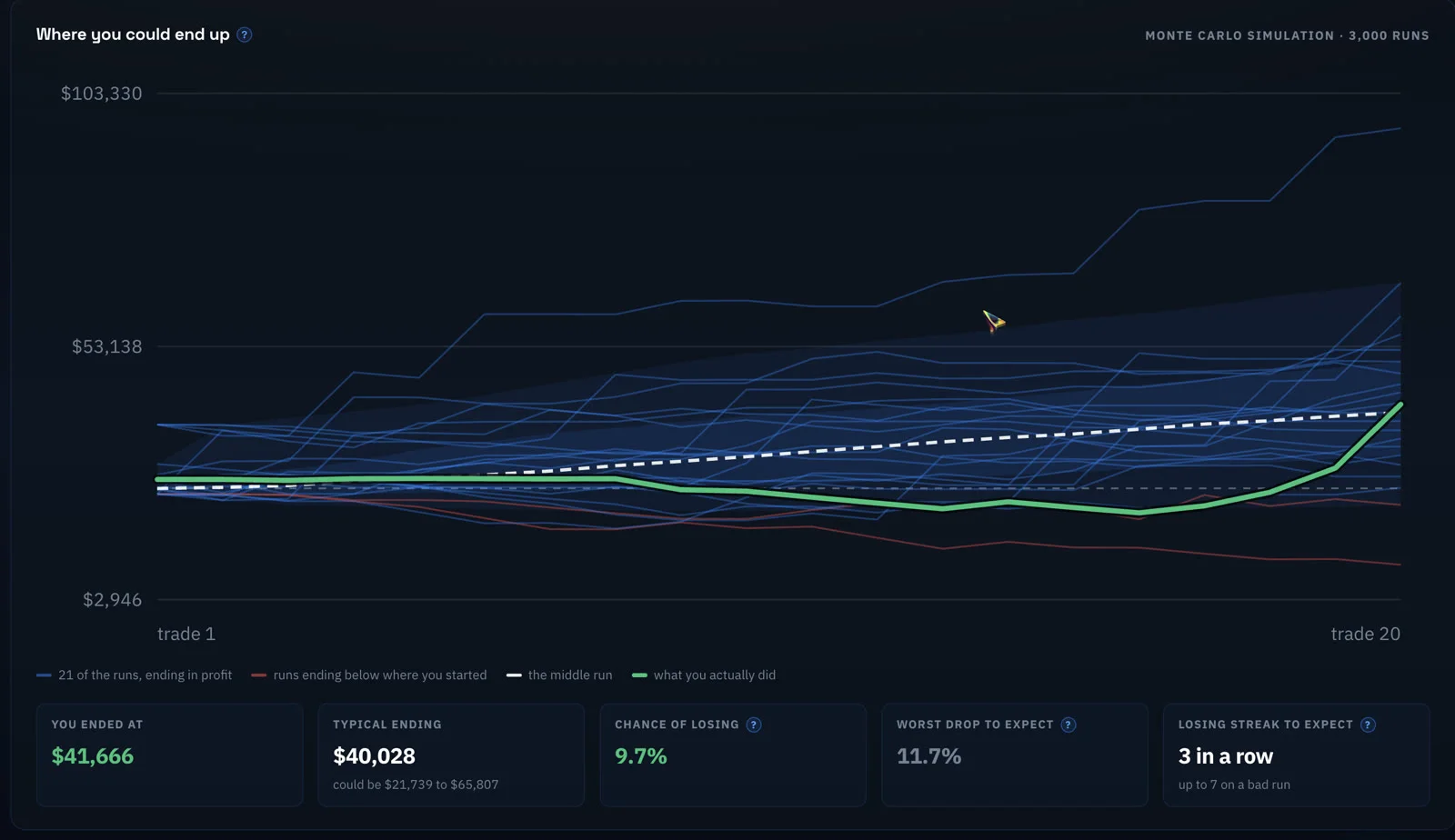
Vektor AI Monte Carlo simulation showing where a strategy could end up across 3,000 runs

Vektor AI →

Find out where the money goes

The 9am hour earns. The 3pm hour gives it back. Ask it questions in plain language.

See Vektor AI

Community →

Results the platform can prove

Every figure on the feed is measured by the platform itself. Records here cannot be edited or invented.

See community

Creators →

Get paid for what you already teach

Post videos, sell strategies and presets, and take payouts in the same place your audience already is. One place for the teaching and the payments, with no separate website to build.

See creator tools

Under it all

The data is the product

A backtest is only worth what the prices behind it are worth. Ours are minute by minute, with the real spread, checked against the exchange.

190M+One minute candles
66Instruments
2019History reaches back to
0Gaps on a trading day

The spread that was really quoted

Every fill pays the bid to ask spread that was really quoted for that minute. A strategy that only survives with costs switched off falls over here, early and for free.

Forex, futures, metals, crypto

Majors and crosses, the CME index and metals contracts and their micros, oil, gold, silver and the big crypto pairs. All on the same clock.

Checked, not just collected

Every series is swept for prices that cannot be real before it is served. A session can only start on a date we can actually draw.

Pricing

Start free, upgrade when the work grows

You do not need a card to begin.

Free

Practice for nothing

$0 / forever

No card needed

Start Free
  • ✓20 credits for Vektor AI (one-time)
  • ✓One replay session at a time
  • ✓Six months of history on MNQ, NQ and every forex pair
  • ✓25 journal entries
  • ✓Core stats and session breakdown
  • ✗Automatic screenshots
Most popular

Edge

Test and sharpen your setups

$12.50 / month

or $140 a year, saving $10

Choose Edge
  • ✓150 credits for Vektor AI, every 48h
  • ✓Three replay sessions at once
  • ✓Forex & CFD history back to 2015
  • ✓Several instruments together
  • ✓Automatic screenshots on every trade
  • ✓AI assistant and creator earnings
  • ✗Strategy DNA and coaching report

Edge+

A coach that reads your whole history

$28 / month

or $320 a year, saving $16

Choose Edge+
  • ✓90 credits for Vektor AI, every 12h
  • ✓Up to ten replay sessions at once
  • ✓Full history back to 2008
  • ✓Results by market type and volatility
  • ✓Consistency and rule break check
  • ✓A graded coaching report
  • ✓Everything in Edge

Community

For traders who have paid in losses, not dollars

Free / earned

No card, just your story

Chat with us

Show us how much you have lost, and how many accounts you have blown. The more honest the story, the better your shot.

  • ✓Tell your trading story, with proof of the losses
  • ✓We read every single one ourselves
  • ✓Free access to EDGE/EDGE+ for a month or more

Every feature side by side

FeatureFreeEdgeEdge+
Replay and data
Active replay sessions1 session3 at onceUp to 10
Several instruments in one session✗✓✓
How far back the data goes6 monthsBack to 2015Back to 2008
Forex, gold, oil, crypto and indices6 monthsBack to 2015Complete (to 2008)
Micro futures (MES, MNQ)MNQ onlyAllAll
Full futures suite (NQ, ES, CL, GC, YM)NQ onlyAllComplete
Journal and analytics
Trade journal and screenshots25, by handUnlimited, automaticUnlimited, automatic
Automatic entry and exit screenshots✗✓✓
Win rate and core stats✓✓✓
Risk and reward breakdown✓✓✓
Forex session radar✓✓✓
Strategy profile and playbook✓✓✓
AI and analysis
AI chat assistant✗✓✓
Vektor AI✗✓✓
Strategy scanner✗✓✓
Does it work verdict and grade✗✓✓
Strategy DNA breakdown✗✗✓
Market regime and volatility mapping✗✗✓
Consistency score✗✗✓
Vektor AI report✗✗✓
Community and earning
Social feed, Hall of Fame and Hall of FailView only✓✓
Creator earnings✗✓✓
Help desk and community✓✓✓
Public trader profile✓✓✓

How it works

From idea to proven edge in three steps

STEP 1

Replay

Pick a market and a date, then trade it forward at whatever pace suits.

STEP 2

Measure

Results are logged as the session runs, so what held up and what did not is there afterwards.

STEP 3

Deploy

Take the parts that worked into your live account, and keep the record running.

Resources

Learn how to test a trading idea properly

Plain guides on backtesting and position sizing, on win rate and prop firm rules. No jargon, and the maths shown where it matters.

Read all the guides Questions people ask How we compare

Put your strategy to the test

Open a session, pick a date, and find out whether a long held belief about the trading survives contact with the data.